- The essential points Trevor Noah makes is that people aren't communicating like they should anymore and are living through their phones. He also points out that people aren't living in the moment anymore and feel the need to capture everything with their phones. I agree because I think phones have made people obsessed with capturing and documenting everything rather than just enjoying the moment.
- Trever describes moments in this chapter that illustrates this like when his mother pretended like she wasn't his mother to the cashier because he kept nagging her about the toffee apple or the whole thing with the letters.
- Fufi was his first heartbreak because he felt betrayed by her for loving the other boy. I did not have any pets growing up.
Friday, 25 April 2025

Friday, 4 April 2025
Trevor Noah’s Born a Crime
1. I don't really know anything about comedians so I couldn't tell you who my favorite comedian is. I think that comedy helps people cope through hard times and lightens their mood.
2. Apartheid's divides people, those of the different or even the same racial group, to keep them from going against the system. The Xhosa and Zulu tribes have different languages and cultures. Trevor Noah's parents are of a different race and were in a relationship which was illegal under the apartheid.
3. Trevor Noah's mom threw him out of a moving vehicle to protect him from a dangerous situation. His mom's strong belief to her faith plays a big role in her decisions. His mother throwing him out of the car was tied to her belief in the power of prayer and spiritual intervention.
4. Taco's are one of the most delicious foods! The mix of so many flavors that work so well together is what makes it so good. What I find striking about Trevor's experience is that to him napkins mean diapers. I learn learning about the difference between someone else's experience and my own because it is intriguing.
Friday, 21 March 2025
Why Should Anyone Care?
Michael Pollan’s “Why Bother"
Conversation
Me: I think we really need to talk about a rising issue of the effects that electronics are having on people's mental health, especially younger people. The long amounts of screen time and lack of real world interactions is causing people to have depression and anxiety.
Companion: Yeah but there isn't really anything you can do about that. You can't just get people to put down their electronics.
Me: That is true but we can take small steps that create small changes that add up. If people set screen limits for themselves or their children and encourage themselves and children to have real life interactions it would help.
Companion: I guess but tech companies are just going to continue to encourage large amounts of screen time.
Me: Public pressure can force that to change. Spreading awareness on this issue with encourage that force.
Companion: I guess your right.
Summary
Pollan answers his own question "Why Bother?" when he argues in his writing that people's small individual actions do make a difference and matter. He acknowledges that its easy to feel like small actions like using less plastic, are too little to make any real difference. He shows that he is against this kind of mindset because change starts with individual actions. If enough amount of people take action, there will be real change that we can see.
Believing Game:
Specialization has made people too dependent on those who specialize in fields and causes us to not have basic life skills. People should be more self reliant as that will make society stronger.
Doubting Game:
Specialization does have its flaws, but it is also something that should be depended on since if everyone were to be things like farmers, progress would slow down. Making it more sustainable is what we should be doing instead of rejecting specialization as a whole.
What can we learn?
Pollen's essay teaches to not only define the problem but connect it to a larger issue.
My Proposal:
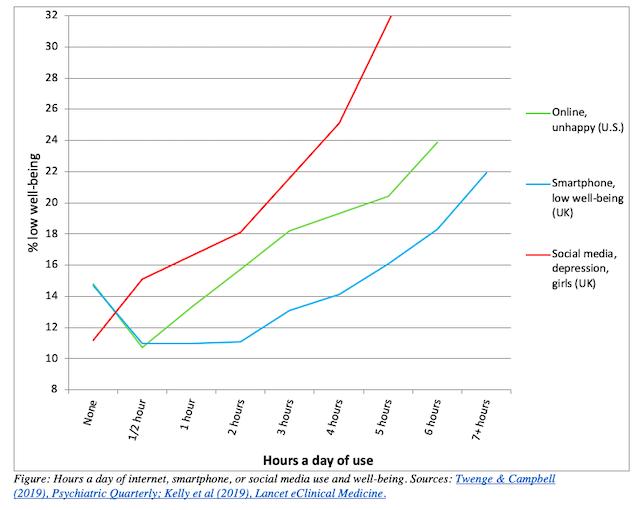
An excessive amount of screen time particularly when it comes to things like phones, video games, and social media especially. There have been lots of studies that have linked excessive amounts of screen time, especially in younger generations, to a rise in depression and anxiety. According to the National Institute of Health, among children ages 14 to 17 years old, high users of screens (7+ h/day vs. low users of 1 h/day) were more than twice as likely to ever have been diagnosed with depression and anxiety. This issue is very concerning considering how electronics are deeply embedded into the way that people live from education to entertainment. To combat this issue, parents should be more strict with the amount of time that their children are spending on their electronic devices. Parents should also not be giving children under the age of 5 devices. Schools should also implement tech free zones that limit the amount of screen time the students are getting. Research shows that reducing screen time even if it is a small reduction, will lead to improvement in mental health.
Thursday, 27 February 2025
Short Story & The Coming of John
Part One:
According to Chimamande Adichie, the danger of a single story is that it creates a stereotype and can be misleading. Single stories makes it hard for people who have bought into the story, to view the people in the story as anything else but the story. Single stories often reduces people/cultures to a narrow, and a lot of the time negative perspective. She introduces a igbo word "nkali" which translates to "to be greater than another". She introduces this word to talk about how those in power control people's narratives. According to Chimamande Adichie, stenotypes are a problem because they don't tell a complete story and can cause people and things to be viewed as simple instead of their complexity. The most important idea I will take with me from this talk is to remember to seek out multiple stories instead of buying into one and that becoming my perspective on something that is more complex, like people.
Part Two:
In the short story, the author compares and contrasts the lives of John Jones who is a black man and John Henderson who is a white man. Both of the men are educated but their lives are vastly different because of their race and how they were treated because of it. John Jones is initially living a carefree life until he becomes aware of the injustice he faces because of his race. John Henderson remains privileged and unaffected by the injustice. I think he chose to write a fictional story instead of a real one because it gives him a better chance at showing a broad problem rather than just giving one real life situation. Education changes John Jones by opening his eyes to the racism and injustice that is around him all the time. I think education can definitely change a person by making them see so many things much differently than they saw before and open their eyes to different perspectives. I think just like Chimamada Achidie talks about how not having a single story can open your eyes to the truth, the short story suggests that education can also open your eyes to the truth.
Jim Crow:
During the Jim Crow era in the south, African Americans faced severe racism through segregation and discrimination. African Americans and white people were segregated from each other with schools, in transportation, public spaces and pretty much everything. African Americans always had the inferior parts of these places. While Black citizens were technically allowed to vote, there were tactics used to suppress their ability to do so. Lynchings and racial violence against African Americans was also very rampant during this time.
Friday, 21 February 2025
Is My SmartPhone Hurting Me?
Are Smartphones Ruining People? Two Different Perspectives Compared!
People have discussed the impact that smartphones have had on younger people for years. In Jean Twenge's essay, "Have Smartphones Destroyed a Generation," She argues that smartphones have contributed to the rise of loneliness, depression, and a lack of social connections among younger people. However, In Sarah Rose Cavanagh's essay "No, Smartphones Are Not Destroying a Generation", It takes a very different stance, it suggests that Twenge’s ideas are an exaggeration and that the effects that technology has had is more nuanced than she is making it out to be.
Now looking at my own experience with smartphones, I got my first smartphone when I was 13. Having a smartphone definitely changed the routine of my daily life. Their were some positive things about having a smartphone like it helped me stay in touch with my friends, sometimes helped me with my schoolwork, and most of all it entertained me. However, I also noticed that spending too much time on my phone made me feel sort of depressed and like I am wasting my life. I noticed myself getting pretty addicted quickly. For example, If I did not have my phone with me all the time of is someone took it from me, I would get stressed out and upset. However, the older I got the more time I could spend away from my phone and live in the moment.
What we can learn from these two arguments is that Twenge raises an important point about the negative effects that too much screen time can have on you. Cavanagh reminds people to look at the bigger picture before blaming smartphones for all the problems. The key idea is to balance between using technology to benefit you in a good way and to not letting it completely control your life.
Friday, 14 February 2025
Deep Dive into the Next Subject
Things I want
- room decor
- a clear idea of what I want for my future
- candy
- money
- a lot of energy
- more sleep
- a pet cat
- more hobbies
The Jury is Still Out
- Whether packing lunches is worth the effort
- My opinions on certain T.V shows
- If waking up early is really better for me
My Media and My Obsessions
- Sza
- TikTok
- Ludo Star
- Barbie Life in the Dreamhouse
Things that bother me
- Slow Wi-Fi
- Hypocritical people
- My phone having a low battery
- Messy or dirty spaces
TikTok vs. SZA
Both scrolling through TikTok and listening to SZA’s music keep me entertained, but in very different ways. TikTok is more fast paced and has endless amount of content. It is both fun and unpredictable, and It can keep me occupied for a very long time without me even realizing it. On the other hand, when I listen to SZA’s music, I can just lay down and let her songs take me somewhere else. It’s not the same kind of entertainment as TikTok, but it definitely keeps me entertained. TikTok is more chaotic and sort of sucks you in with the large amount of content. Listening to SZA's music is less overwhelming and instead calm but still entertaining.
The biggest difference between scrolling on TikTok and listening to SZA is how I feel in the end. Usually, after I scroll through TikTok for a while, I feel like I sort of wasted a lot of my time on something that wasn't important to me. When I listen to SZA, I don't feel like I wasted time and instead like I had a break from life.
Friday, 7 February 2025
Sherlock Holmes Fairies and the Devil Baby of Hull House
1. Conan Doyle failed on his case because his own personal beliefs got in the way of him thinking about this case logically. He misinterpreted evidence and ruled out the two girls who had taken the photos. He fully believed in the existence of fairies and was acting on that belief.
2. Many of the women who went to the Hull House all had a shared feeling of hardships in life like loss, loneliness, and being victims. One woman shared that she had lost a child and was seeking comfort. Since they were vulnerable they want something where their hardships can be answered and where they can have faith. Similar to Conan Doyle who had lost people he cared about in the war and sought comfort and faith in believing in fairies.
3. I agree with Doyle because people's understanding of the world is always changing. New theories are always being proven so believing that there are some things that are just beyond science isn't crazy. Though I can't think of a specific mystery that I think is beyond science.
4. Mermaids who are half human and half fish who have been in folktales and stories for years. So many people have claimed to have seen them jumping from the water or swimming on the top.
Subscribe to:
Posts (Atom)
Travel Guide to South Africa
South Africa: Land of Diversity Travel Guide South Africa is located at the southernmost part of the African continent. The country is ren...

-
Michael Pollan’s “Why Bother" Conversation Me: I think we really need to talk about a rising issue of the effects that electronics ar...
-
Are Smartphones Ruining People? Two Different Perspectives Compared! People have discussed the impact that smartphones have had on younger ...
-
Part One: According to Chimamande Adichie, the danger of a single story is that it creates a stereotype and can be misleading. Single stori...
